The purpose of this page is to give examples of rings.
Examples of Rings
Example 1: Let ![\mathbb{R}[x]](https://malachialexander.com/wp-content/ql-cache/quicklatex.com-81b3828ad1ba2599e253638498256bf4_l3.svg "Rendered by QuickLaTeX.com") be the set of polynomials with coefficients in
be the set of polynomials with coefficients in  . Let
. Let  and
and  , assume that
  , then we define addition and multiplication by:
![\[f(x)+g(x)=a_nx^n+ \cdots +a_{m+1}x^{m+1} +(a_m+b_m)x^m + \cdots + (a_1+b_1)x + (a_0+b_0)\]](https://malachialexander.com/wp-content/ql-cache/quicklatex.com-5bfdf80553964ed34a5e742f4ad5e64e_l3.svg "Rendered by QuickLaTeX.com")
![\[f(x)g(x)=a_nb_m x^{m+n} + (a_nb_{m-1}+a_{n-1}b_m)x^{m+n-1} + \cdots + a_0b_0\]](https://malachialexander.com/wp-content/ql-cache/quicklatex.com-19f8422a106b3fd7989ce45ece843618_l3.svg "Rendered by QuickLaTeX.com")
In other words, they are exactly what you think they should be. Clearly, by adding and multiplying polynomials, we obtain a polynomial. Thus, the subset is closed under this operation. The additive identity is the zero polynomial:
 . For any polynomial
  , it’s additive inverse is given by:
 ![\[-f(x)=-a_nx^n -a_{n-1}x^{n-1} - \cdots - a_1x -a_0\]](https://malachialexander.com/wp-content/ql-cache/quicklatex.com-0bdeb8fee4c23f5a61cafb987a47f5c6_l3.svg "Rendered by QuickLaTeX.com")
The multiplicative identity is the constant polynomial
 .
.
Example 2: Let  be the set of rational functions with coefficients in , i.e. elements are of the form
  , where
  and
and  are polynomials and
  . Let
. Let  and
and  , then we define addition and multiplication by:
![\[r_1(x)+r_2(x)=\frac{p_1(x)}{q_1(x)}+\frac{p_2(x)}{q_2(x)}=\frac{p_1(x)q_2(x)+p_2(x)q_1(x)}{q_1(x)q_2(x)}\]](https://malachialexander.com/wp-content/ql-cache/quicklatex.com-ad9192e5604303fdca45d3e44fd68ac6_l3.svg "Rendered by QuickLaTeX.com")
![\[r_1(x)\cdot r_2(x)=\frac{p_1(x)}{q_1(x)}\cdot\frac{p_2(x)}{q_2(x)}=\frac{p_1(x)p_2(x)}{q_1(x)q_2(x)}\]](https://malachialexander.com/wp-content/ql-cache/quicklatex.com-c4dfb46ca95894e75001912e351e0e9e_l3.svg "Rendered by QuickLaTeX.com")
The additive identity is
and multiplicative identity and for any , the additive inverse is  and the multiplicative inverse (if
  ) is
) is  .
.
Example 3: Let  be the set of real-valued functions with domain
  , i.e.
  . For any two functions
  , we define addition and multiplication by:
![\[(f+g)(x)=f(x)+g(x) \text{ and } (fg)(x)=f(x)g(x)\]](https://malachialexander.com/wp-content/ql-cache/quicklatex.com-ced890c23c9095e47b7b79c962b9efa1_l3.svg "Rendered by QuickLaTeX.com")
The additive identity is the constant function
and the multiplicative identity is the constant function . The additive inverse of is  .
.
Example 4: The set of real-valued continuous functions with domain is a ring under the same operations in Example 3.
Example 5: The set of real-valued (infinitely) differentiable functions with domain is a ring under the same operations in Example 3.
Examples of Ring Homomorphisms
Example 6: Let be the set of real-valued function with domain as in Example 3. Let  , then the evaluation homomorphism
  at
at  is defined by
  . This is in fact a ring homomorphism.
Proof: Let ,
![\[\text{ev}_c(f+g)=(f+g)(c)=f(c)+g(c)=\text{ev}_c(f)+\text{ev}_c(g)\]](https://malachialexander.com/wp-content/ql-cache/quicklatex.com-bd5a7c3587f6e11a87a41220991756ac_l3.svg "Rendered by QuickLaTeX.com")
![\[\text{ev}_c(f\cdot g)=(f\cdot g)(c)=f(c)\cdot g(c) = \text{ev}_c(f)\cdot\text{ev}_c(g)\]](https://malachialexander.com/wp-content/ql-cache/quicklatex.com-f6e95abe71d305563dba1de89ca9be14_l3.svg "Rendered by QuickLaTeX.com")
and
 .
.
Example 7: Let  be defined by conjugation, i.e. for any
  ,
,  . Then,
  is a ring homomorphism.
Proof: Let  and
and  , then,
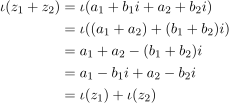

and
 .
.
Example 8: Let  be defined by:
![\[\varphi(a+bi) = \begin{pmatrix} a & b \\ -b & a \end{pmatrix}\]](https://malachialexander.com/wp-content/ql-cache/quicklatex.com-9521647d5f1b8af07875c6062c275578_l3.svg "Rendered by QuickLaTeX.com")
Proof: Let
and , then 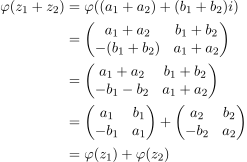

![\[\varphi(1)=\begin{pmatrix} 1 & 0 \\ -0 & 1 \end{pmatrix} = I_2\]](https://malachialexander.com/wp-content/ql-cache/quicklatex.com-00544835e9409090b3be2c935df71332_l3.svg "Rendered by QuickLaTeX.com")
Note that for the proof of the multiplication condition for the ring homomorphism, one may consider computing
 and
and  and pretend as if they knew exactly how the multiplication decomposes by connecting the ending results by equal signs.