In elementary school, we learn to count using the decimal system where we have ten digits (the prefix deci refers to breaking numbers into tenths), the digits are:
![\[0\;1\;2\;3\;4\;5\;6\;7\;8\;9\]](https://malachialexander.com/wp-content/ql-cache/quicklatex.com-a07c8a4946a8edb7f02b97b2e4315951_l3.svg "Rendered by QuickLaTeX.com")
 number system. However, we do not necessarily need to use a decimal number system to count with numbers, in fact, we could do all of mathematics in a different base
  number system. For example, consider the binary number system with base
  , where our two digits are
  and
and  . For example,
  in base
  is the same as
  is base 10.
 ![\[(101)_2=2^2\cdot 1 + 2^1\cdot 0 +2^0\cdot 1= 5\]](https://malachialexander.com/wp-content/ql-cache/quicklatex.com-03d70896f1684ca1cc17385e6f213ee6_l3.svg "Rendered by QuickLaTeX.com")
 , we can use our normal digits
  cutting off at the appropriate number so that the list contains digits.
 Example: Convert
 to base 10.
 to base 8.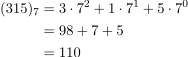
 ,
,  ,
,  ,
,  and
and  . We have that
  so we stop taking powers since we will not receive a remainder if we divide
  by
by  or any larger power of . Now,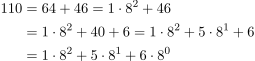
 .
.
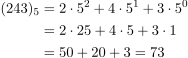
Exercise: Convert  to base 10.

Exercise: Convert  to base 10.
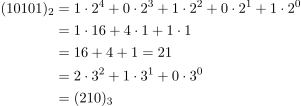
Exercise: Convert  to base 3.
Let the digits of a base
 number system be given by:
 ![\[0\;1\;2\;3\;4\;5\;6\;7\;8\;9\;\text{A}\;\text{B}\;\text{C}\;\text{D}\;\text{E}\;\text{F}\]](https://malachialexander.com/wp-content/ql-cache/quicklatex.com-ae65f397e404d0ace5cbb656144bf13f_l3.svg "Rendered by QuickLaTeX.com")
Example: Convert
 into to base .

Exercise: Convert  into to base .

Related Topic: Adding and Subtracting Numbers in Different Bases