Purpose
The purpose of this activity is give some strategies to reducing large powers using modular relations.
The purpose of this activity is give some strategies to reducing large powers using modular relations.
Reduction Techniques for  .
.
(1) Reduce the base of exponentiation  modulo
  .
.
(2) Look at powers of  , then split the power with respect to a nice power of .
(3) If is a prime, apply Fermat’s Little Theorem.
Example 1: Determine  .
.
Using Technique (1),  , therefore,
![\[30^{70} \equiv 3^{70} \mod 27\]](https://malachialexander.com/wp-content/ql-cache/quicklatex.com-d8044ba8d653617f60bd6ef1a52dd34c_l3.svg "Rendered by QuickLaTeX.com")
Using Technique (2), observe that

It is much easier to compute
 then it is
  . Therefore, we split the power with respect to
  , i.e.
  . Therefore,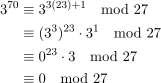
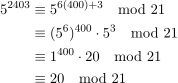
Example 2: Determine  .
.
Using Technique (1),  , therefore,
![\[125^{801}\equiv 5^{2403} \mod 21\]](https://malachialexander.com/wp-content/ql-cache/quicklatex.com-29792d63be1df4a85fa7df1e6cf58057_l3.svg "Rendered by QuickLaTeX.com")
Using Technique (2), observe that
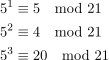
Note that
 . Therefore,
  and
and  ,
,