Mathematical induction is the result of taking advantage of special properties of the natural numbers. However, one can establish axioms for what constitutes “the natural numbers.” There are a few approaches to defining the natural numbers, but I find the “Peano axioms” to be the most intuitive. In this page, I omit several details because the overall purpose is not to construct the natural numbers, but to understand the Principal of Induction at a slightly different perspective then you may have seen and review some facts we should know.
 be a nonempty set (called the underlying set),
  (called the distinguished element of ), and
  be a function (which will be referred to as the successor function). We say the triple
  is a Peano system if:
- For all
 ,
,  .
. - For all
 , if
, if  , then
  .
. - If
 such that
  and
and  implies
  , then
  .
.
We refer to the third axiom as the “axiom of induction.” Two facts can be established quickly:
 is a bijection from onto
Proof: By (1),  . By (2), is injective, thus we only need to show surjectivity. Set
  . Now, clearly, . If
  , then since
  and
and  are both subsets of , thus
  . Therefore, by (3), .
 For all ,  .
.
Proof: Let  . By (1), . By (2), if , i.e. , then
  (applying the contrapositive), thus . Therefore, by (3), , i.e. for all .
 Using the successor function, one can prove the existence of a unique notion of addition and multiplication on
satisfying all of the many properties we are familiar with: For all  ,
,
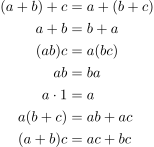
 , only one of the following conditions hold:
-

- There exists such that

- There exists such that

We see that  where
where  defined by
  satisfies the Peano axioms. The axiom of induction plays an essential role in establishing the validity of “proof by induction” as a method of proof. In fact, using the Peano axioms, one can prove that “proof by induction” is valid.
be a Peano system and let  be a property associated to the element . If
  is true and is true implies
  is true for all , then is true for all .
 Proof: Let
 . By is true, . By is true implies
  is true, we have implies . Therefore, by the axiom of induction, , i.e. is true for all .
 There are two variations often discussed:
The Principle of Mathematical Induction: Let be a Peano system and let be a property associated to the element . If for some ,  is true and is true implies is true for all
  , then is true for all .
The Strong Principle of Induction: Let be a Peano system and let be a property associated to the element and fix  . If for each
  ,
,  is true for
  implies is true, then is true for all
  .
.
Exercise: Prove that  for all
  .
.
Proof: Let be the property that . It is clear  , i.e. is true. Suppose
  , then
![\[2^{k+1}=2^k>k\cdot 2 = k+k \geq k+1\]](https://malachialexander.com/wp-content/ql-cache/quicklatex.com-b38517b564df9c3401e5c3e9e7fc8566_l3.svg "Rendered by QuickLaTeX.com")
for all .
Exercise: Prove that  for all .
Proof: Let be the property that . It is clear  , i.e. is true. Suppose
 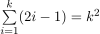 , then
![\[\sum\limits_{i=1}^{k+1} (2i-1)= \sum\limits_{i=1}^k (2i-1) + (2(k+1)-1)=k^2 +2k+1 = (k+1)^2\]](https://malachialexander.com/wp-content/ql-cache/quicklatex.com-70de2512928578aded6004fd3d408a1c_l3.svg "Rendered by QuickLaTeX.com")
is true for all .
Exercise: Show that  distinct points on the real line divides the real into
  intervals.
Proof: Choosing distinct points on the real line corresponds to choosing a real number. Let  , then the real line is split into two intervals
  and
and  . Assume that
  distinct points divide the real line into
  intervals. Let
  be distinct points in
  such that
  . By the inductive hypothesis,
  divide the real line into intervals
  where
where  . Then,
  splits
  into two intervals
  and
and  . Therefore, points splits the real line into
  intervals.
 Note: We are applying induction that any point in an interval divides any interval into two subintervals since
is itself an interval.
Exercise: Prove that  .
.
Proof: Clearly,  . Assume that
  , then
![\[\frac{d^{k+1}}{dx^{k+1}}e^{cx}=\frac{d}{dx}\frac{d^k}{dx^k}e^{cx}=\frac{d}{dx}c^ke^{cx}= c^k\frac{d}{dx}e^{cx}= c^{k+1}e^{cx}\]](https://malachialexander.com/wp-content/ql-cache/quicklatex.com-9510a2e7e1f1d803765b5e3f2018fcf6_l3.svg "Rendered by QuickLaTeX.com")
.
Exercise: For all  , show that
  .
.
Proof: Clearly,  , thus
  . Let
. Let  , then
![\[5^{k+1}-1=5(5^k)-1-4+4 = 5(5^k-1)+4 = 5(4q)+4 = 4(5q+1)\]](https://malachialexander.com/wp-content/ql-cache/quicklatex.com-f49233f368fa97170bacc77fe6f8afcb_l3.svg "Rendered by QuickLaTeX.com")
for all .