3.3 The Binomial Theorem and Pascal’s Triangle
Exercise 1 What is the coefficient of the term  of
of  ?
?
By the Binomial Theorem, we have:
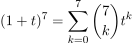
 .
.
Exercise 2 What is the coefficient of the term  of
of  ?
?
By the Binomial Theorem, we have:
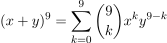
 .
.
Exercise 3 What is the coefficient of the term  of
of  ?
?
By the Multinomial Theorem, we have:

 .
.
Exercise 4 Use the binomial theorem to compute  (you don’t have to simplify, just write it out).
By the Binomial Theorem, we have:
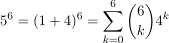
Exercise 5 Let  .
.
(a) How many subsets are there of size
There are  subsets of size
  .
.
(b) How many subsets are there of size divisible by
There are  subsets of size divisible by
  .
.
(c) How many subsets are there of size divisible by
There are  subsets of size divisible by
  .
.
.
(a) How many subsets are there of size ?
There are subsets of size .
(b) How many subsets are there of size divisible by ?
There are subsets of size divisible by .
(c) How many subsets are there of size divisible by ?
There are subsets of size divisible by .
3.4 Congruences of binomial coefficients
Exercise 1 Reduce  modulo
  .
.
Note that
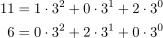
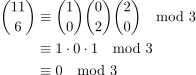
Exercise 2 Use Lucas’s Theorem to determine if  .
.
Note that
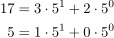

 .
.
3.5 Permutations
Exercise 1 Let
(a) Compute
(b) Compute
(c) Find a formula for
(d) Find a formula for
![\[\sigma=\begin{pmatrix} 1& 2 & 3 & 4 & 5 & 6 \\ 2 & 1 & 4 & 5 & 6 & 3 \end{pmatrix}\]](https://malachialexander.com/wp-content/ql-cache/quicklatex.com-23a23263185fe0fc241f0c8dbf5072ed_l3.svg "Rendered by QuickLaTeX.com")
(a) Compute  ,
,  ,
,  ,
,  ,
,  , and
, and  .
.

(b) Compute  ,
,  ,
,  .
.

(c) Find a formula for  where
where  means apply
 times.

(d) Find a formula for  where means apply times.

Exercise 2 Rewrite the following permutations in one-line notation:
(a)
(b)
(c)
(d)
(a) 
![\[(1\;2\;3\;4)\]](https://malachialexander.com/wp-content/ql-cache/quicklatex.com-ac66d358348e338123b4b9a89bcce779_l3.svg "Rendered by QuickLaTeX.com")
(b) 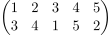
![\[(1\;3)(2\;4\;5)\]](https://malachialexander.com/wp-content/ql-cache/quicklatex.com-15f541ef3c4702fa519960f5d5513a93_l3.svg "Rendered by QuickLaTeX.com")
(c) 
![\[(1\;5)(2\;4)\]](https://malachialexander.com/wp-content/ql-cache/quicklatex.com-a67b67108f0fe418dfcd76f0bb158b5c_l3.svg "Rendered by QuickLaTeX.com")
(d) 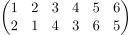
![\[(1\;2)(3\;4)(5\;6)\]](https://malachialexander.com/wp-content/ql-cache/quicklatex.com-c43573dd322ad6092eb7aca9a8997c77_l3.svg "Rendered by QuickLaTeX.com")
Exercise 3 Rewrite the following permutations in two-line notation (assume each permutation is an element of  :
:
(a)
(b)
(c)
(d)
:
(a) 
![\[\begin{pmatrix} 1 & 2 & 3 & 4 & 5 \\ 2 & 4 & 1 & 5 & 3 \end{pmatrix}\]](https://malachialexander.com/wp-content/ql-cache/quicklatex.com-04f8942181679031e6f2f2c6d01fbdde_l3.svg "Rendered by QuickLaTeX.com")
(b) 
![\[\begin{pmatrix} 1 & 2 & 3 & 4 & 5 \\ 2 & 1 & 3 & 5 & 4 \end{pmatrix}\]](https://malachialexander.com/wp-content/ql-cache/quicklatex.com-6fe3ffc60ed3124086cfc2000379bbd5_l3.svg "Rendered by QuickLaTeX.com")
(c) 
![\[\begin{pmatrix} 1 & 2 & 3 & 4 & 5 \\ 3 & 1 & 2 & 4 & 5 \end{pmatrix}\]](https://malachialexander.com/wp-content/ql-cache/quicklatex.com-1080955aba0eb1e71ff0e154d76e6908_l3.svg "Rendered by QuickLaTeX.com")
(d) 
![\[\begin{pmatrix} 1 & 2 & 3 & 4 & 5 \\ 3 & 4 & 2 & 1 & 5 \end{pmatrix}\]](https://malachialexander.com/wp-content/ql-cache/quicklatex.com-ed37f374c80e02bddcbe6223b0f07ff2_l3.svg "Rendered by QuickLaTeX.com")
Exercise 4 How many transpositions (permutations which switch exactly two elements) are there in  ?
?
Any transposition can be given in the form  and
and  , i.e. choosing a transposition is equivalent to choosing two elements from a set of four objects in which order does not matter. Therefore, there are
  transpositions.
Exercise 5 How many cycles are there in ?
Any cycle is of the form  . Shifting any cycle by one does not change the permutation, i.e.
  . Thus, there are a total of five representations of the same cycle. Therefore, there are
  cycles in .
Exercise 6 Show that there exists a bijection between edges on a graph with  vertices and the transpositions in
  .
.
Label the vertices of the graph by  . For each transposition in , send it to the edge connected the vertex
  and
and  . Note that and the edge connecting to is the same as the edge connecting to . Therefore, this defines a bijection between transpositions and edges of the graph.
3.7 Selections
Exercise 1 Let  and consider how many ways to create a string of -letters.
 possible strings.
 possible strings.
 possible strings.
 possible strings.
and consider how many ways to create a string of -letters.
(a) How many possible strings are there if repetition is allowed and order matters?
There are possible strings.
(b) How many possible strings are there if repetition is not allowed and order matters?
There are possible strings.
(c) How many possible strings are there if repetition is allowed and order does not matter?
There are possible strings.
(d) How many possible strings are there if repetition is not allowed and order does not matter?
There are possible strings.
Exercise 2 Suppose an urn contains five balls with different colors: aqua, burgundy, crimson, dandelion, eggshell. How many ways can we select three balls if:
 possible selections.
 possible selections.
 possible selections.
 possible selections.
(a) Balls are returned to the urn after each choice and order matters.
There are possible selections.
(b) Balls are returned to the urn after each choice and order does not matter.
There are possible selections.
(c) Balls are not returned to the urn after each choice and order matters.
There are possible selections.
(d) Balls are not returned to the urn after each choice and order does not matter.
There are possible selections.
Exercise 3 How many solutions are there to the following equation:
![\[x_1+x_2+x_3=5\]](https://malachialexander.com/wp-content/ql-cache/quicklatex.com-4e6816462e2e012f7f4865478fe91ab8_l3.svg "Rendered by QuickLaTeX.com")
if each  is a non-negative integer.
There are  possible solutions.
3.8 Equivalence and order
Exercise 1 Let , determine if the following relations are: (1) reflexive, (2) symmetric, (3) transitive, (4) irreflexive, or (5) antisymmetric.
(a) Let
Reflexivity fails from .
.
Symmetry fails from , but
, but  .
.
Transitive fails from,  , but
, but  .
.
Irreflexivity fails from .
.
(b) Let
Reflexivity fails form .
.
Antisymmetry fails from and  .
.
Transitivity fails from and , but .
Irreflexivity fails from .
.
, determine if the following relations are: (1) reflexive, (2) symmetric, (3) transitive, (4) irreflexive, or (5) antisymmetric.
(a) Let  .
.
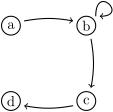
Reflexivity fails from
. Symmetry fails from
, but . Transitive fails from
, , but . Irreflexivity fails from
.
(b) Let  .
.
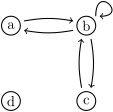
Reflexivity fails form
. Antisymmetry fails from
and . Transitivity fails from
and , but . Irreflexivity fails from
.