2.4 Orders of magnitude
Exercise 1 Show that  .
Note that for  ,

 ,

 for all
 , i.e.
 .
Exercise 2 Show that  .
We must show that  for some constant
 and for all
 for some natural number
 . Suppose, I choose an arbitrary
 , say
 , then

 , say
 . Then, we show by induction
 . The base case is given by
 . Assume
 , then

 for all
 as
 for . Thus

.
Exercise 3 Let  be a polynomial with non-negative coefficients (with
 ). Show that
 . You may use
 .
Note that

.
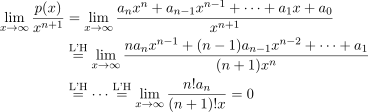
Exercise 4 Let be a degree polynomial (i.e. ). Show that  .
Note that
.
Exercise 5 Let  . Show that
 .
Note that

.
Exercise 6 Let  . Show that
 .
Note that

.
2.5 Different ways of counting
Exercise 1 Let  . The number of labelled families of subsets of
 is
 . Determine which of the unlabeled families of subsets are the same:
(a)
The permutation  in
 provides a bijection between the labeling, thus they are the same unlabeled family.
(b)
Note that  is contained in both families, thus any permutation designating a bijection between the two families must fix
 and
 . But
 and
 implies that the permutation must also switch
 and , which is impossible. Therefore, they are different unlabeled families.
(c)
The permutation  in provides a bijection between the two families. Therefore, they are the same unlabeled family.
(d)
Note that the first collection contains all unique elements of and the second does not, this tells us there does not exist a bijection (otherwise there is a bijection between a set with 3 and 4 elements). Therefore, they are different unlabeled families.
. The number of labelled families of subsets of is . Determine which of the unlabeled families of subsets are the same:
(a)  and
 .
The permutation in provides a bijection between the labeling, thus they are the same unlabeled family.
(b) and  .
Note that is contained in both families, thus any permutation designating a bijection between the two families must fix and . But and implies that the permutation must also switch and , which is impossible. Therefore, they are different unlabeled families.
(c)  and
 .
The permutation in provides a bijection between the two families. Therefore, they are the same unlabeled family.
(d)  and .
Note that the first collection contains all unique elements of and the second does not, this tells us there does not exist a bijection (otherwise there is a bijection between a set with 3 and 4 elements). Therefore, they are different unlabeled families.
Exercise 2 Let . How many distinct unlabeled families of subsets are there which consist of a  -set and -set?
There are only two distinguishable cases, when the -set and -set share an element of and when the -set and -set don’t share any elements. Thus, there are two unlabeled families.
Exercise 3 How many labeled graphs are there on four vertices?
A graph is determined by its vertices and edges. In this case, the number of vertices is fixed. Note that any edge can be determined by a choice of two vertices (in which order does not matter). Therefore, there are . We can then ask if each of the edges are in the graph or not, thus we have
 graphs.
Exercise 4 How many unlabeled graphs are there on four vertices and 2 edges?
Begin by selecting any edge. Then, either we can select another edge which does not share an vertex with our first choice or we can select the second edge which shares one vertex. Therefore, there are only two unlabeled graphs when the graph has four vertices and two edges.
2.6 Double counting
Exercise 1 True or False: If the same set is counted in two different ways, the answers are the same.
True. (Imagine if this was not true, we could never give a well-defined answer)
2.7 Appendix on set notation
Let  and
 . Find the following:
Exercise 1

Exercise 2

Exercise 3

Exercise 4

Exercise 5

Exercise 6

Exercise 7

Exercise 7

Exercise 8

Exercise 9

and . Find the following:
Exercise 1 
Exercise 2 
Exercise 3 
Exercise 4 
Exercise 5 
Exercise 6 
Exercise 7 
Exercise 7 
Exercise 8 
Exercise 9 
3.1 Subsets
Recall that if  , then a function
 can be represented by an ordered -tuple
 . Therefore, we can associate a base 2 integer to each subset of . Let
 , then we can define
 .
Exercise 1 Let
 and
 are integers which represent subsets that contain
 .
, then a function can be represented by an ordered -tuple . Therefore, we can associate a base 2 integer to each subset of . Let , then we can define .
Exercise 1 Let  , which integers represent subsets which contain .

and are integers which represent subsets that contain .
3.2 Subsets of fixed size
Exercise 1 Which subset is counted by  ?
The empty set  since we are selecting
 elements from a set of objects.
Exercise 2 Which subset is counted by  ?
The whole set since we are selecting elements from a set of objects.
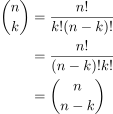
Exercise 3 Algebraically prove the following identities:
(a)
(b)
(c)
(a) 
(b) 
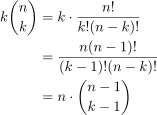
(c) 

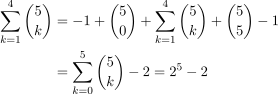
Exercise 4 Compute:
(a)
(b)
(a) 
(b) 

Exercise 5 When  , what is
 ?
We define  when .