Chapter 4: Recurrence Relations and Generating Functions
Exercise 1 Solve the recurrence relation:
![\[f(n)=6f(n-1)-11f(n-2)+6f(n-3)\]](https://malachialexander.com/wp-content/ql-cache/quicklatex.com-2ba50e94f4b30e7f362afd0849222cae_l3.svg "Rendered by QuickLaTeX.com")
where  ,
,  and
and  .
Hint: The roots of the characteristic polynomial are rational.
.
Hint: The roots of the characteristic polynomial are rational.
The characteristic polynomial is  . Using the Rational Root Test, we obtain that the roots are
  ,
,  , and
, and  . The roots of the polynomial are unique, thus the general solution is of the form:
![\[f(n)=c_1(1)^n+c_2(2)^n + c_3(3)^n\]](https://malachialexander.com/wp-content/ql-cache/quicklatex.com-31543447207a5bbeedf31b321ce8152d_l3.svg "Rendered by QuickLaTeX.com")
, and , we obtain the system of linear equations:
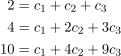
 ,
,  and
and  . Therefore, the recurrence relation is given by
  .
.
Exercise 2 Find the general solution to the following recurrence relation.
![\[f(n)=3f(n-2)+2f(n-3)\]](https://malachialexander.com/wp-content/ql-cache/quicklatex.com-3924c3b4fef728dc22ca48ca1c74012d_l3.svg "Rendered by QuickLaTeX.com")
Hint: The roots of the characteristic polynomial are rational.
The characteristic polynomial is  . Using the Rational Root Test, we obtain that the roots are
  (with multiplicity 2) and (with multiplicity 1). Therefore, The general solution is of the form:
![\[f(n)=c_1(-1)^n+c_2n(-1)^n+c_3(2)^n\]](https://malachialexander.com/wp-content/ql-cache/quicklatex.com-c25b0caa81b51274fcf9fc222d9d1bcf_l3.svg "Rendered by QuickLaTeX.com")
Exercise 3 Suppose each of the following permutations are in  . Determine which of the following permutations are derangements.


(a) is a derangement since  for
for  and
and  .
. (b)
is a derangement since  ,
,  ,
,  ,
,  and
and  .
. (c)
is not a derangement since  .
. (d)
 . Therefore,
  . Therefore, it is not a derangement.