Chapter 11: Graphs
Exercise 1 Determine the following properties of each graph:
- Is the graph simple or a multigraph?
- Is the graph complete?
- Is the graph connected? If not determine the number of components?
- Is the graph a tree or forest?
- Determine the degrees of the vertices.


Graph A: Simple, complete, connected, not a tree, there are three vertices of degree 2. Graph B: Simple, not complete, connected, tree, there are five vertices of degree 1 and a vertex of degree 5.
Graph C: Simple, not complete, not a tree, there are four vertices of degree 2.
Graph D: Simple, not complete, connected, not a tree, there are two vertices of degree 2, two vertices of degree 3 and one vertex of degree 4.
Graph E: Simple, not complete, not connected, there are two components, a forest, there are four vertices of degree 1.
Graph F: Simple, not complete, connected, tree, there are four vertices of degree 1 and one vertex of degree 4.
Exercise 2 Let  be the graph given by:

Determine if the following walks are a:
- trek
- trail
- path
- cycle
- circuit
Walk A: 
Walk B: 
Walk C: 
Walk A: It is a trek and trail. Walk B: It is a trek, trail, and path.
Walk C: It is a cycle.
Exercise 3 How many trails and paths does the following graph have?
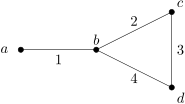
Trails: four of length 0, eight of length 1, eight of length 2, ten of length 3, four of length 4. Paths: four of length 0, eight of length 1, twelve of length 2, four of length 3.
Exercise 4 A graph has 18 edges and 10 vertices. If 3 vertices have degree 6 and the remaining vertices have degree 2 and 3, how many vertices are there degree 2 and 3?
If there are edges, then the sum of the degrees of the vertices must be
  . Let
. Let  be the number of degree
  vertices and
  be the number of degree
  vertices. Note that there are
  vertices, of which are degree
  . Therefore, we have
  and we can set
  .
.

vertices and four degree vertices.
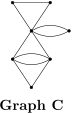
Exercise 5 Determine if the following graphs have an Eulerian circuit or Eulerian trail:


Graph A: Eulerian trail. Exactly two odd degree vertices. Graph B: Eulerian trail. Exactly two odd degree vertices.
Graph C: Eulerian circuit. All vertices are of even degree.
Exercise 6 Determine how many spanning trees the following graph has:

There are  spanning trees by Cayley’s Theorem (11.2.4).