Purpose
The purpose of this activity is give you extra practice solving systems of modular equations using the Chinese Remainder Theorem.
The purpose of this activity is give you extra practice solving systems of modular equations using the Chinese Remainder Theorem.
Chinese Remainder Theorem: Let  be pairwise coprime and set
  . For any choice
  , there exists a solution
  to the system of congruences:

Moreover, if
 is a solution then the set of all solutions is equal to
  .
.
How Do We Actually Solve?
Step 1: Set  , where
  .
.
Step 2: Find  , with
  , i.e. find the inverse of
  in
in  .
.
Step 3: Compute  , this is the solution.
Example 1
Solve the following system of modular equations:

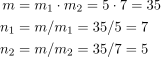
Step 1: Let
 and
and  and
and  and
and  .
. 
Step 2: Find
 such that
  and
and  . By Fermat’s Little Theorem:
Step 3: The solution is
 .
.Verification:

Therefore, the set of solutions is
 .
.
Example 2
Solve the following system of modular equations:

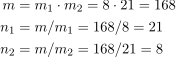
Step 1: Let
 and
and  and
and  and
and  .
. 
Step 2: Find
such that  and
and  . By applying Bezout’s Theorem,
Step 3: The solution is
 .
. ![\[\begin{array}{rcccc}&&q_i&u_i&v_i \\i=0: &&& 0 & 1 \\i=1: & 21=8(2)+5 & 2 & 1 &-2 \\i=2: & 8=5(1)+3 & 1 & -1 & 3 \\i=3: & 5=3(1)+2 & 1 & 2 &-5 \\i=4: & 3=2(1)+1 & 1 & -3 & 8 \\i=5: & 2=1(2)\end{array}\]](https://malachialexander.com/wp-content/ql-cache/quicklatex.com-9ca8d15bc96e6fa7aab9e8c388367211_l3.svg "Rendered by QuickLaTeX.com")
Therefore
 . Warning: In this case, we obtain both
  and
and  , but this is not the case when dealing with more equations.
Verification:

Therefore, the set of solutions is
 .
.