 , however, we can use utilize tools and intuition from analysis (calculus) to understand their growth rates.
 Motivation: Let
 ,
,  and
and  (we will really only consider on the domain
  ). Suppose we wanted to understand which function grows faster as the input increases. We cannot simply say that
  , even though intuitively cubic polynomials should be larger than quadratic polynomials. In particular,
![\[3=g(1)> h(1)=1 \text{ and } 9=g(2)>h(2)=8 \text{ and } 19=g(3)<h(3)=27\]](https://malachialexander.com/wp-content/ql-cache/quicklatex.com-3f1fee8080382938f878e0c929b87680_l3.svg "Rendered by QuickLaTeX.com")
 , we have that
  . Therefore, we can quickly conclude that simply comparing the functions will not give us the flexibility we’d like. Therefore, we need an approach which focuses on long-term behavior.
 Definition Let
 . We say
  if
if  asymptotically grows at most the same rate as
  , i.e.
  for some
  and sufficiently large
  . This is known as big-O notation.
 Example: Let
 and
and  , then
  when
when  . Therefore,
  .
. Of course, we could any
 ; however, it does not matter in showing . It is more common to consider a more basic function such as
  . In the next example, we will see multiple choices for
  ,
, Example: Let
 and . Note
  no longer works here. Since
  for all .
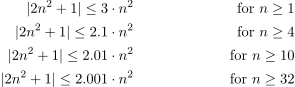
 .
. In this case, we can choose  . The reason is, we must overcome the constant term
  , so is not enough.
Exercise: Show that  . Hint: Consider a function such that
  .
.
For any  and functions and ,



Example: Let
and  . Note that earlier, we had
  .
Therefore,
.
Therefore, ![\[\vert 2n^2+1\vert \leq 1\cdot n^3\]](https://malachialexander.com/wp-content/ql-cache/quicklatex.com-86863afa80463b33b8a892452cc9e9e5_l3.svg "Rendered by QuickLaTeX.com")
for
. Therefore,  .
.
Therefore, we have seen that  and . This is because
  grows asymptotically at most the same rate as both and
  . This can cause some confusion because of the usage of “
 .” This is simply because grows faster than and thus every function which is
  is necessarily
  as well (if you grow at most as fast as , then clearly you should grow at most as fast as ). There are variations of the big-O, we list them all (including big-O for reference):
Let ,
- if asymptotically grows at most the same rate as , i.e.
 for some and
  sufficiently large. This is big O.
 -
 if asymptotically grows at least the same rate as , i.e.
  for some and sufficiently large. This is big Omega.
 -
 if asymptotically grows the same rate as , i.e.
  and . This is big Theta.
 -
 if asymptotically grows slower than , i.e.
  . This is little o.
 -
 if asymptotically grows faster than , i.e.
  . This is little omega.